The eco entrepreneur who invented a surf board made entirely from mushrooms and coral
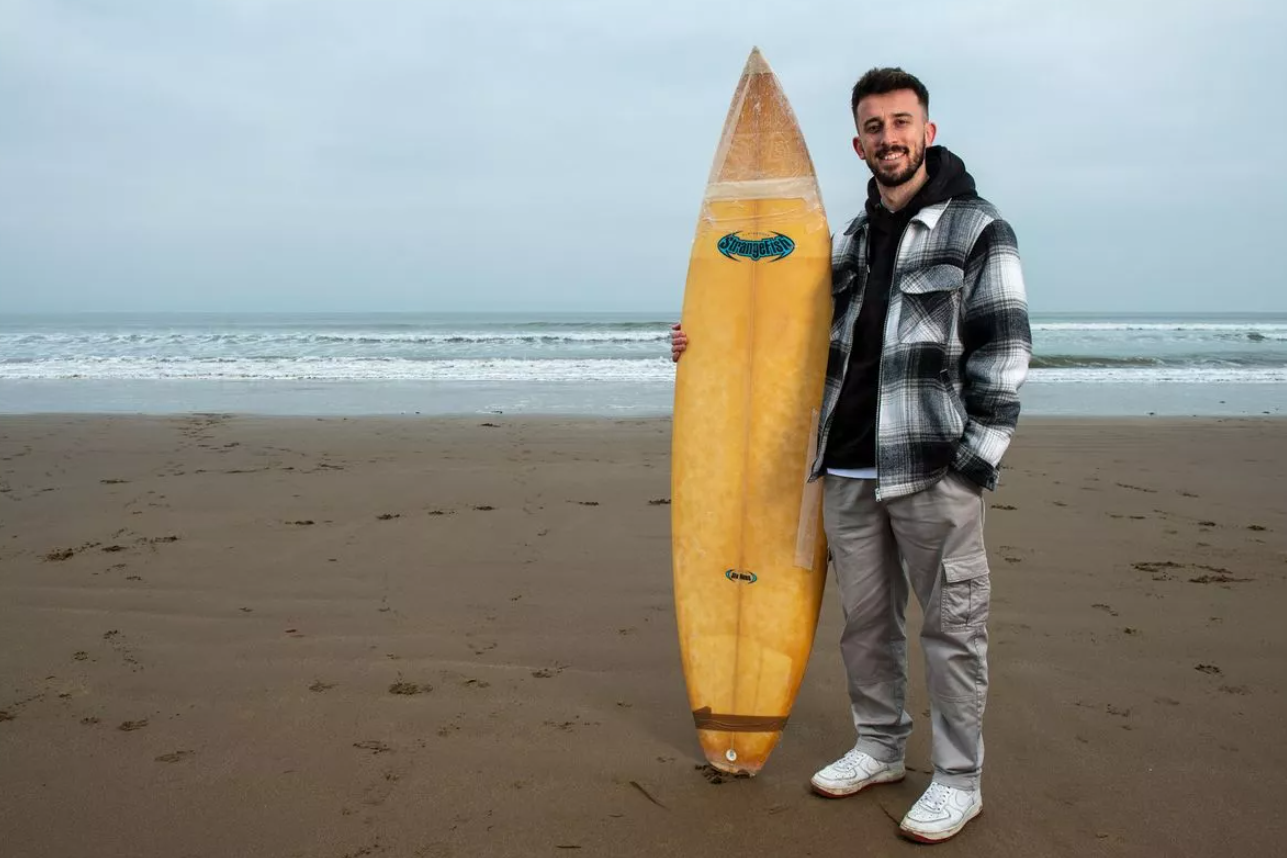
Image by Mark Lewis
First published on 12/03/23
These days, there’s no excuse not to try and be more sustainable in your lifestyle. You’ve heard it all- from reusable coffee cups, to biodegradable toothbrushes. Now, the latest invention. A surfboard made from mushrooms.
According to a prominent study carried out at the University of California Berkeley, the average surfboard creates 375 pounds of CO2 emissions in the production process.
That’s equivalent to about 16,500 fully charged phones, and the amount plastic pollution that an abandoned board can produce is also extremely damaging to marine life. But one surfer from Porthcawl has come up with the solution. 23-year-old Steve Davies is hoping the shift in the way people view the climate crisis will encourage them to switch to a product that actually benefits the planet rather than causing it harm.
Steve was undertaking a masters degree in product design at Cardiff Metropolitan University when he started working with this unique concept, as he was looking into the impact that surfing has on the planet as well as undertaking material research into Mycelium packaging. He found out that lots of surfboard users don't know what to do when a board cracks or breaks and people can end up dumping them.
It can then be left in landfill, or a board that's cracked in the water can be washed up on the beach, injuring people or animals. Steve grew up very close to the beach, and was disheartened by how much damage is being done to the ocean which has also given him so much.
His vision was to create a board which uses a coral skeleton frame which gives it strength and can decompose to the bottom of the ocean or planted there. The second element is Mycelium. Mycelium is a network of fungal threads or hyphae, or in simpler terms, the spores from mushrooms which grow a mushroom root. Steve took the material and mixed it with agricultural waste, which in this case is straw.
These are then bound together over 20 days which is the “growth period”, according to Steve. “Within this is a 3D printed inner skeleton in a coral replicating shape, from a compostable material," he explained.
Read this piece here.